SCGD Accelerates Toward Net Zero 2050, Advancing Clean Energy Investments and Cost Reduction Through Digital Technology and Automation to Enhance Competitive Edge Across ASEAN

SCG Decor Public Company Limited (SCGD) is accelerating concrete progress toward its Net Zero target by 2050, alongside sustainable business growth plans. As of 2024, the company has achieved over 35% reduction in Greenhouse Gas Emissions compared to the 2020 baseline through two primary strategies: first, investing in renewable energy projects including solar power and biomass fuel, with plans to expand renewable energy usage across manufacturing bases throughout ASEAN; and second, Implementing business restructuring with digital technology and automation systems to enhance production efficiency, reduce costs, and elevate organizational management capabilities.
For 2025, SCGD estimates total capital expenditure of over 2 billion baht, with planned investments of over 1.5 billion baht in clean energy projects and production efficiency improvements. These investments will reduce carbon emissions while strengthening long-term competitive capabilities. The renewable energy projects implemented in 2024 have already reduced energy costs by over 300 million baht annually, with projects completed in the first half of 2025 expected to deliver additional annual savings of 36 million baht. Simultaneously, business restructuring through digital technology and automation systems has enhanced operational efficiency, achieving total cost reductions of over 60 million baht annually, with additional cost savings anticipated in subsequent periods.

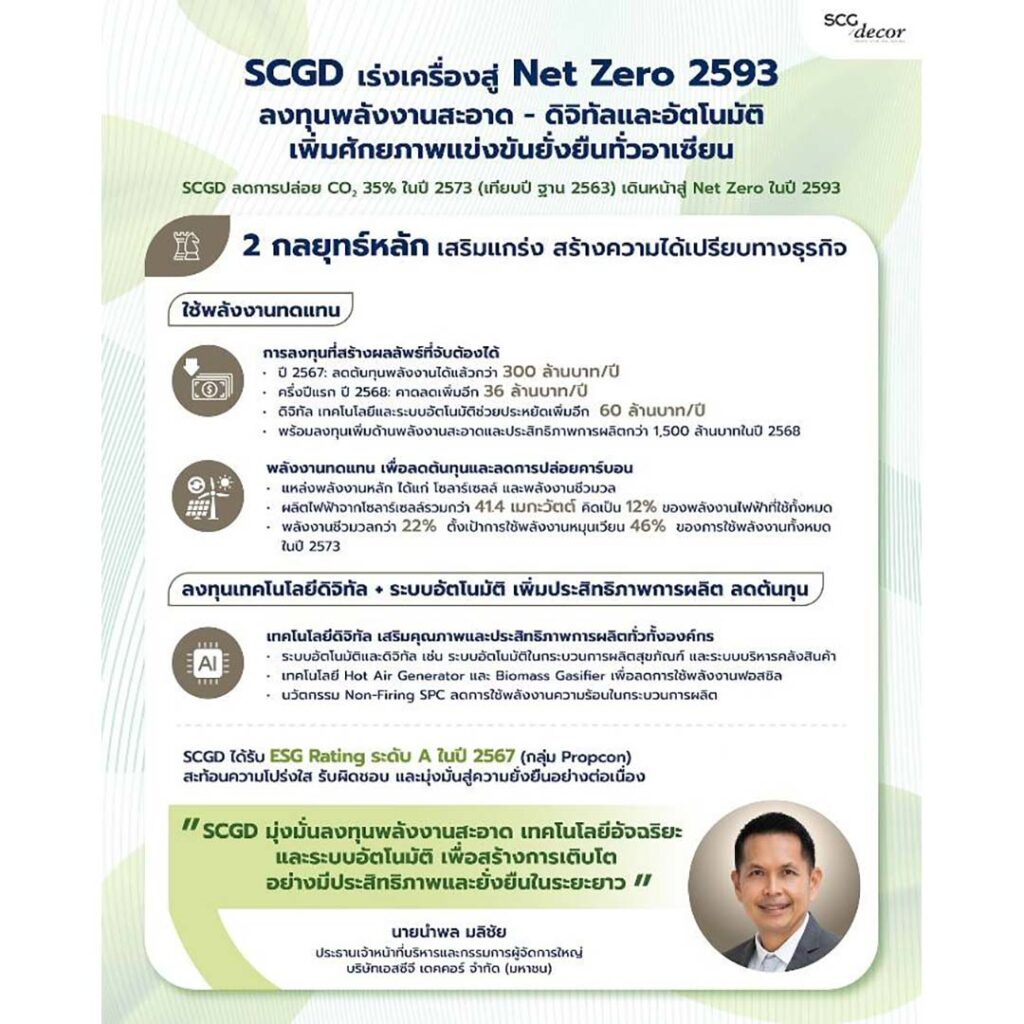
Mr. Numpol Malichai, Chief Executive Officer and President of SCG Decor Public Company Limited, revealed that “SCGD advances sustainability in business operations as one of the core strategies used to strengthen the business. The over 35% carbon emission reduction in Scope 1 and 2 from the 2020 baseline results from long-term planning, efficient cost management, and renewable energy technology investments, enabling the business to compete effectively and sustainably in the market.”